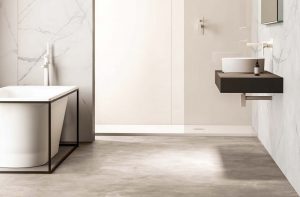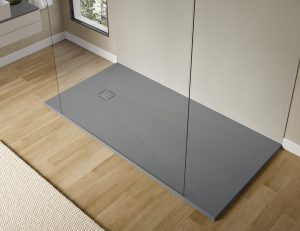
Choosing a shower tray may seem like a simple decision until you start comparing materials. One of the most common dilemmas during a renovation is choosing between a resin shower tray and a porcelain shower tray, two very different solutions in terms of both design and performance.
Although porcelain has been the most common choice in bathrooms for decades, materials have evolved considerably. Today, so-called resin shower trays —actually manufactured using mineral-based materials and technical resins— offer new possibilities in terms of design, customization, safety and installation.
So, which is better? The answer depends on the needs of each project, the budget and how the bathroom will be used.
In this guide, we analyze the differences between both materials objectively to help you make the best decision.
What is a porcelain shower tray?
Porcelain shower trays belong to the family of ceramic products. They are made from clays and other mineral materials that are molded, fired at high temperatures and subsequently vitrified to obtain a smooth, durable and easy-to-clean surface.
For many years, they have been one of the most widely used solutions in new-build homes and renovations thanks to their good balance between price and performance.
However, the ceramic manufacturing process also influences the design of the product. The need to use molds and the characteristics of the material itself limit aspects such as shapes, radii, textures and the availability of large formats. In addition, most of the market focuses on white finishes and fairly traditional designs, while color options are usually reserved for premium ranges.
Nevertheless, porcelain remains a perfectly valid alternative for those looking for a functional, simple solution that is very easy to maintain.
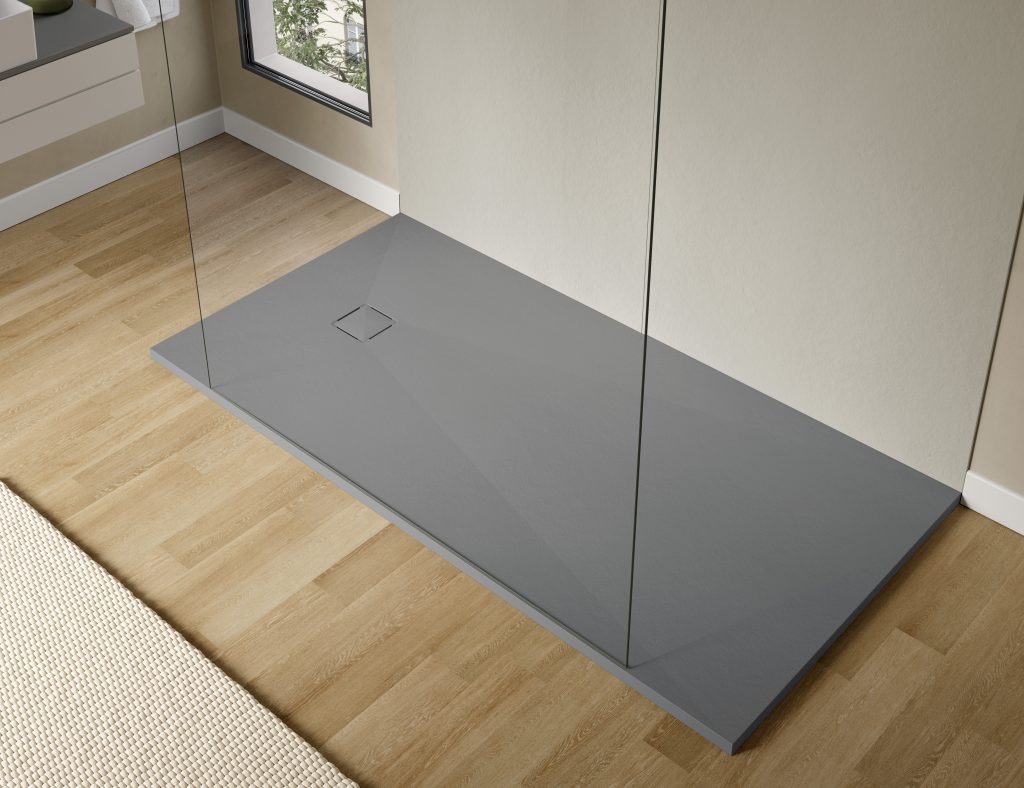
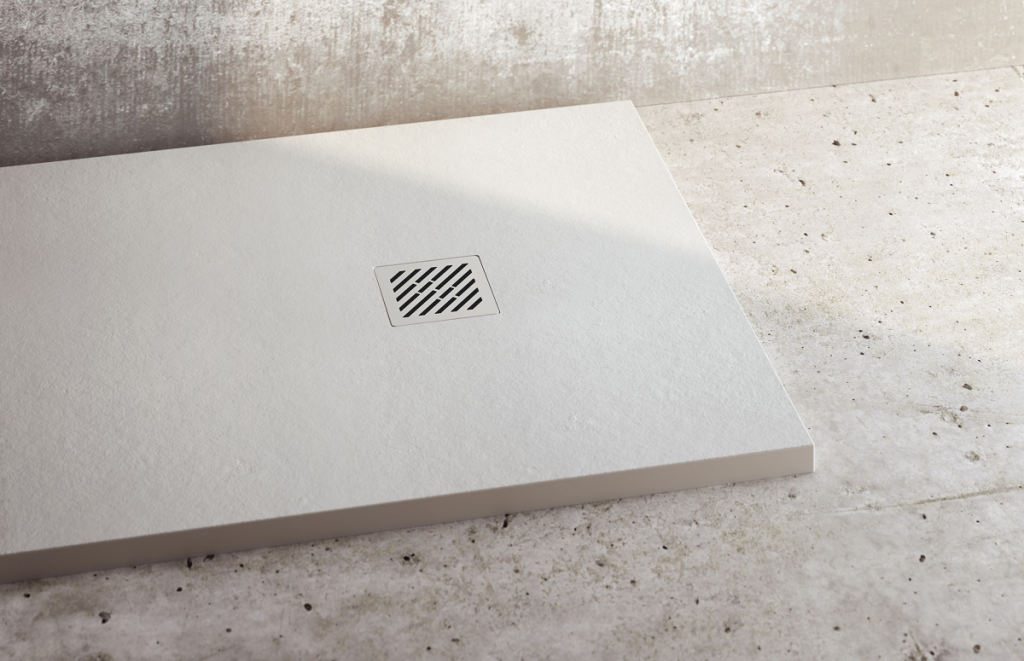
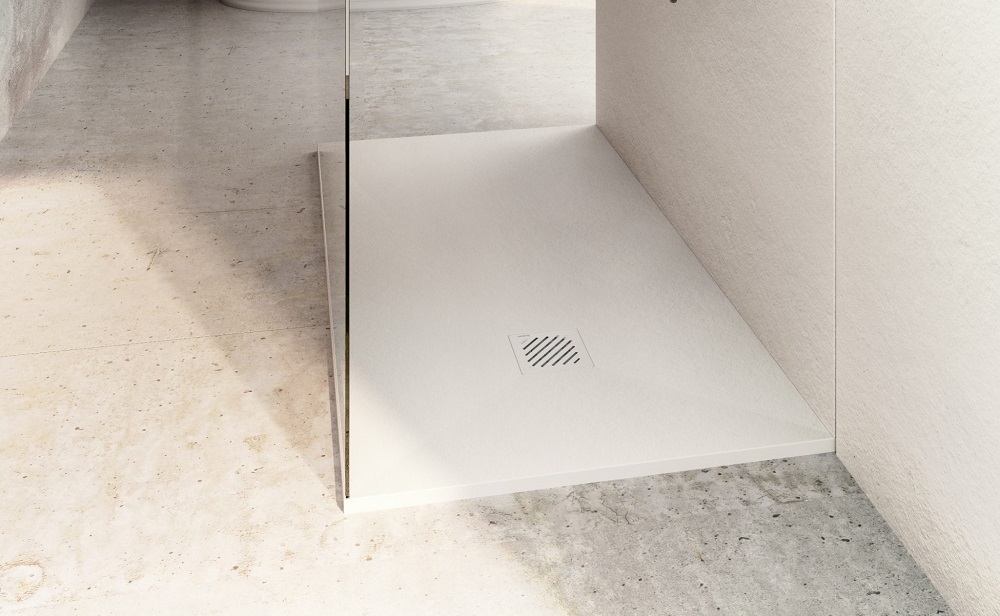
Quadrattia shower tray
What is a resin shower tray?
Although they are commonly known as resin shower trays, the reality is that most current mid- and high-range products are made with mineral-based materials combined with high-performance technical resins.
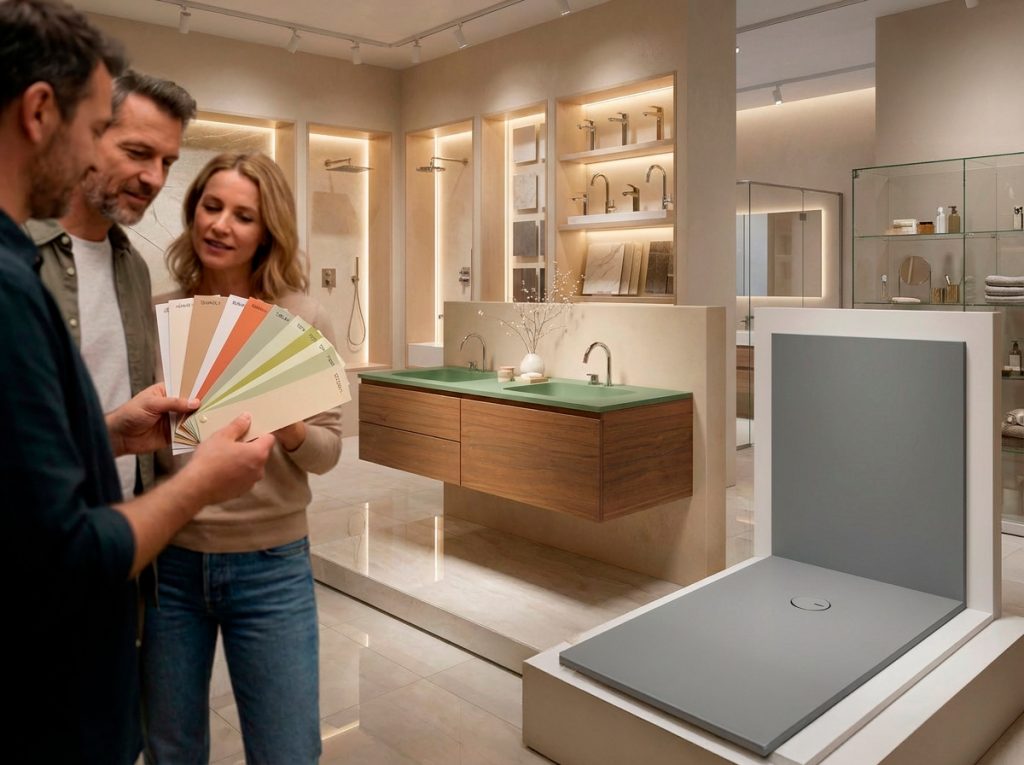
This composition makes it possible to create much more versatile pieces from both a design and installation perspective, offering finishes that realistically reproduce natural stone, concrete or different contemporary textures.
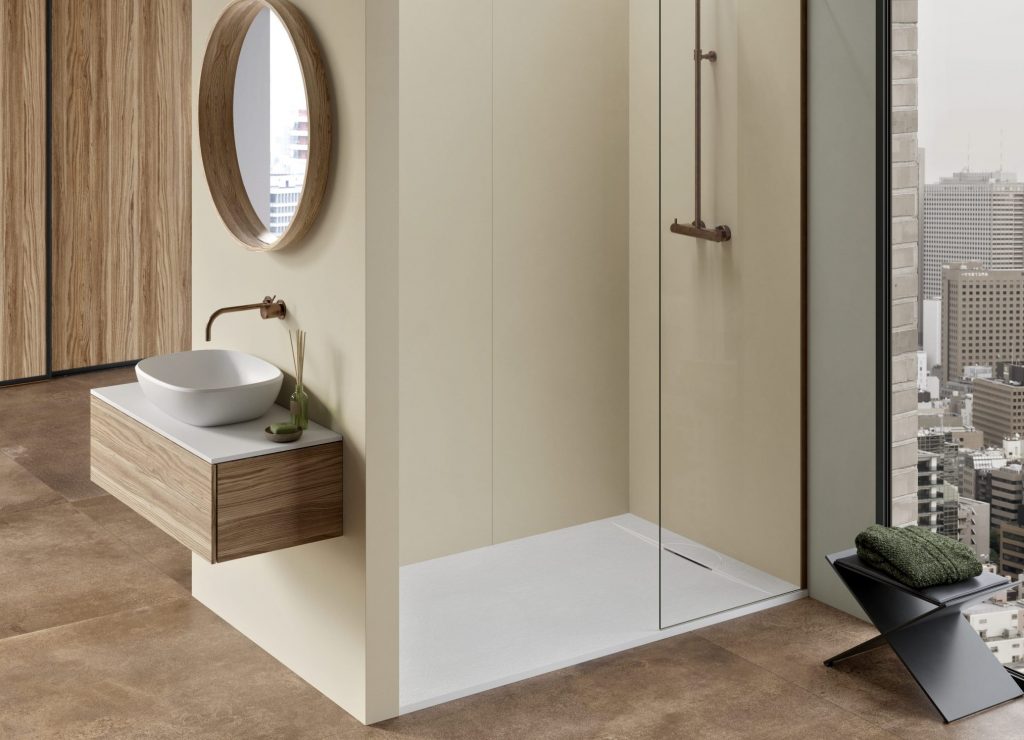
In addition, mineral-based materials make it possible to manufacture ultra-slim shower trays with cleaner lines, a wide range of colors and numerous sizes, including made-to-measure solutions to fit virtually any space.
Another advantage is that many models can be adjusted during installation when the project requires it, which is particularly useful in renovations where walls are not always perfectly square. They also stand out for their repairability, dimensional precision and ability to offer large formats at competitive prices.
For these reasons, shower trays made from mineral-based materials have become the predominant choice in a large proportion of today’s bathroom renovations.
Resin vs porcelain: the evolution of the contemporary bathroom
Until just a few years ago, the choice of a shower tray was largely determined by the available range. Porcelain dominated the market and differences between manufacturers were relatively small.
Today, the situation is very different. The demand for more open, accessible and personalized bathrooms has driven the development of new materials capable of offering better performance without sacrificing design.
Therefore, rather than asking which of the two materials is «better», it is worth analyzing the areas in which each one stands out:
- Which offers greater design freedom?
- Which is safer for everyday use?
- Which makes installation easier during a renovation?
- Which provides a greater sense of comfort?
- Which maintains its appearance better over time?
In the following sections, we will compare both materials point by point to help you identify which one best suits your project.
Differences between a resin shower tray and a porcelain one
Although both serve the same purpose, there are important differences worth knowing before choosing a shower tray.
Our experience as a manufacturer allows us to see that many questions arise during the renovation, when the material has already been chosen. That is why it is advisable to consider aspects such as the possibility of cutting the tray, repairability or the availability of special sizes from the outset, as these criteria can make a difference in everyday use and in the final result of a renovation.
Below, we analyze the main comparison criteria.
Design and customization options
Design is one of the areas in which the bathroom sector has evolved the most in recent years.
While porcelain shower trays retain a more traditional aesthetic, trays made from mineral-based materials allow much more contemporary and personalized designs to be developed.
This translates into a greater variety of:
- colors
- textures
- formats
- dimensions
- finishes
In addition, these materials make it possible to manufacture ultra-slim shower trays with cleaner lines and lower profiles, facilitating integration with the bathroom floor and creating visually more spacious areas.
By contrast, the limitations inherent in the ceramic manufacturing process mean that most porcelain shower trays have simpler designs, wider radii and a much more limited range of colors, with white predominating across most of the market.
Which one should you choose?
- If you are looking for a contemporary, fully integrated bathroom, mineral-based materials offer far more design possibilities.
- If you prefer a classic and functional aesthetic, porcelain remains a good alternative.
Safety: which material is less slippery?
Safety is one of the most important factors, especially in family homes, hotels or adapted bathrooms.
Shower trays made from mineral-based materials can incorporate textured surfaces capable of achieving the highest anti-slip classifications, providing a high level of grip even when the tray is wet. This characteristic is part of the product’s surface design itself and does not depend solely on subsequent treatments.
In porcelain, anti-slip properties are usually achieved through specific treatments applied to the surface. In addition, glossy finishes —very common in this type of tray— can create a greater visual impression of slipperiness.
This does not mean that a ceramic shower tray is unsafe, but it is always advisable to check its anti-slip classification before choosing a model.
Sense of comfort
There is one aspect that many people only discover once they start using the bathroom: the sensation the material provides on first contact.
Mineral-based materials have a warmer surface to the touch and absorb the temperature of the water and surrounding environment more quickly, providing a greater sense of comfort while showering.
Porcelain, by contrast, usually feels colder, especially during the winter months or in bathrooms with lower temperatures.
It may seem like a minor detail, but it is a difference that many users notice from the very first use.
Durability and resistance to daily use
Both porcelain and mineral-based materials can provide a long service life when they are quality products that have been properly installed.
However, the two materials behave differently when faced with everyday minor accidents.
Ceramic stands out for its surface hardness, but a strong impact can cause chips or breaks that cannot be repaired.
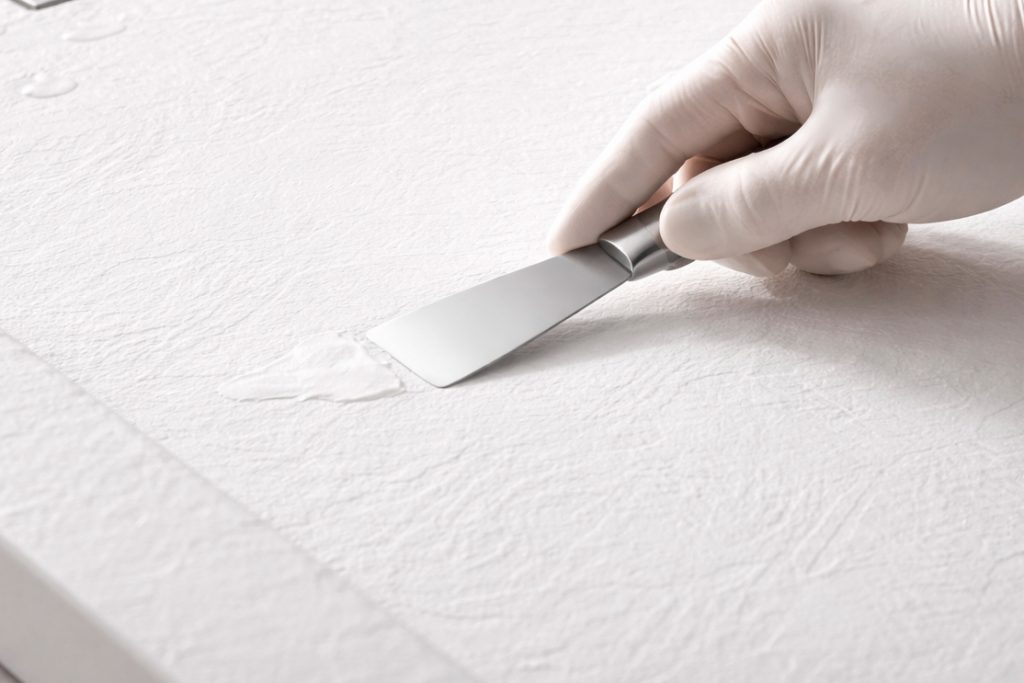
Mineral-based materials, on the other hand, offer high resistance to daily use and, if surface damage occurs, many models allow invisible repairs to be carried out on the shower tray, extending the product’s service life.
This repairability is an important advantage in homes where the shower tray is subject to intensive use.
Cleaning and maintenance
In this respect, both materials offer very satisfactory performance.
The vitrified surface of porcelain makes everyday cleaning extremely easy and withstands the passage of time very well.
Mineral-based materials also have non-porous surfaces that make it difficult for dirt to accumulate and facilitate easy cleaning with suitable products.
In both cases, it is advisable to follow the manufacturer’s maintenance instructions to preserve the original appearance for longer.
It could be said that neither material has a decisive advantage in this respect.
Installation and adaptation during renovation
One of the aspects least known to end users is the influence the material has during installation.
In a new-build project, where all dimensions are perfectly defined, this difference may go unnoticed.
However, in a renovation, walls are rarely perfectly square.
This is where mineral-based materials offer a particularly interesting advantage.
Many models can be cut and adjusted during installation to fit the available space precisely, reducing the need for additional modifications on site. They also have very tight dimensional tolerances, making a more precise fit possible.
Porcelain shower trays, by contrast, cannot be cut on site and require the available opening to be adapted beforehand to the product’s dimensions.
For the installer, this represents an important difference and, in many renovation projects, can also translate into time savings and easier installation.
Environmental impact
The manufacturing process is also an increasingly valued aspect during a renovation. While manufacturing ceramic products requires firing processes at very high temperatures and high energy consumption, mineral-based materials allow production processes with lower energy requirements. In addition, many manufacturers incorporate natural raw materials into their composition, contributing to more efficient production.
What about weight?
There is a common belief that resin shower trays are much lighter than porcelain ones. However, this is not always the case.
Mineral-based materials tend to have a high density that provides stability to the whole structure, while ceramic shower trays have a similar weight. Even so, increasingly lightweight options are available among resin and mineral-filled shower trays, with the Gravitzero model from Nuovvo being one of the lightest shower trays on the market, weighing just 7.5 kg/m² while remaining equally resistant.
Quick comparison
| Feature | Mineral-based materials | Porcelain |
|---|---|---|
| Design | ⭐⭐⭐⭐⭐ | ⭐⭐⭐ |
| Colors | Very wide variety | Mainly white |
| Textures | Very varied | Limited |
| Ultra-slim profile | Yes | More limited |
| Feel to the touch | Warm | Cold |
| Anti-slip | Very high depending on the finish | Depends on the treatment |
| Repair | Possible | Not repairable |
| Cutting during installation | Yes | No |
| Large formats | Widely available | More limited |
| Dimensional precision | Very high | Lower |
| Cleaning | Very easy | Very easy |
| Weight | Similar | Similar |
Which material should you choose for your project?
There is no single perfect material for every bathroom. The choice will depend on the type of project, the available budget and each user’s priorities.
A porcelain shower tray can be a good choice if:
- you are looking for a simple and functional solution;
- you prioritize a lower initial cost;
- you prefer a classic aesthetic.
A shower tray made from mineral-based materials is especially recommended if:
- you want a contemporary bathroom design;
- you want to choose from different colors and textures;
- you are looking for an ultra-slim shower tray integrated with the floor;
- you value greater adaptability during installation;
- you need special sizes or large formats;
- you prioritize comfort and safety in everyday use.
The reality of the market shows that mineral-based materials have greatly expanded the design possibilities of the modern bathroom. For this reason, they are the choice in a large proportion of current renovations when the goal is to combine aesthetics, functionality and customization.
Frequently asked questions about resin and porcelain shower trays
Which shower tray is better: resin or porcelain?
There is no single answer, as it depends on the needs of each project.
If you are looking for a functional shower tray at a contained cost, porcelain remains an interesting alternative.
On the other hand, if you value design, customization, the possibility of installing an ultra-slim shower tray, greater adaptability during renovation or a surface with a high level of anti-slip performance, mineral-based materials offer more possibilities.
The choice should be made by considering the project as a whole, not just the price of the product.
Do resin shower trays last for many years?
Yes.
Shower trays made from mineral-based materials are designed to withstand intensive daily use.
As with any other bathroom element, durability will depend both on product quality and on correct installation and proper maintenance.
In addition, one of their advantages is that small marks or surface damage can be repaired on many models, extending their service life.
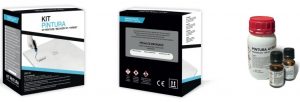
In many cases, minor surface damage can be repaired without replacing the shower tray. If you want to learn about the process, you can consult our guide on how to use the shower tray repair kit.
Which shower tray is less slippery?
Slip resistance depends on the surface finish and each manufacturer’s anti-slip classification.
Many shower trays made from mineral-based materials incorporate textures capable of achieving the highest anti-slip classifications, providing excellent safety even when the surface is wet.
In any case, it is always advisable to check the anti-slip classification before making a purchase, regardless of the material chosen. For example, Nuovvo shower trays with Slate texture have anti-slip class 3, the highest according to UNE 41091:2017.
Which material is easier to clean?
Both porcelain and mineral-based materials have easy-to-maintain surfaces.
Routine cleaning can be carried out with suitable products recommended by the manufacturer, avoiding excessively abrasive substances that could alter the finish.
With proper maintenance, both materials retain their appearance for many years.
Can a shower tray be cut to adapt it to the bathroom?
It depends on the material.
Many shower trays made from mineral-based materials can be adjusted during installation to fit the available space.
Ceramic shower trays, by contrast, are not designed for this type of modification on site.
This difference is particularly interesting in renovations where walls have slight deviations or when it is necessary to make the most of the available space.
What is the best option for a renovation?
In most current renovations, mineral-based materials offer greater flexibility.
The ability to choose different sizes, colors and textures, together with their suitability for ultra-slim installations and their ability to be adjusted during installation, makes them an especially versatile solution for renovation projects.
However, every bathroom is different, and it is advisable to consider all requirements before making a decision.
Conclusion
Choosing between a porcelain shower tray and one made from mineral-based materials is not simply a matter of comparing prices.
Other factors also come into play, such as design, safety, ease of installation, comfort during daily use and the ability to customize the space.
Porcelain remains a practical and functional solution that has proven its reliability for decades.
However, the evolution of bathroom design has driven the development of materials capable of offering new possibilities to users, architects, interior designers and installers alike.
For this reason, today shower trays made from mineral-based materials have established themselves as one of the preferred options for those looking to create contemporary, accessible and personalized bathrooms.
The best choice will always be the one that meets the specific needs of your project and the way the bathroom will be used.
Why choose a Nuovvo shower tray?
At Nuovvo, we have spent years developing shower trays designed to combine design, innovation and functionality.
Our collections are manufactured using high-performance mineral-based materials and are designed to meet the needs of today’s architecture and interior design: ultra-slim profiles, a wide range of sizes, multiple textures and colors, and solutions capable of integrating into residential, hotel and contract projects.
Beyond design, we focus on aspects that make a difference in everyday use, such as safety, ease of installation and product durability.
If you are planning a renovation or a new-build project, we invite you to discover all the possibilities offered by our shower tray collection and find the solution that best suits your bathroom.